
I like to travel. Not the Instagram kind. I mean getting properly lost in a busy district, ending up somewhere with a couple of drinks in hand and no idea what time it is. I like it best when night falls and the streets shift. The food markets open up, people start drinking, someone’s already too drunk, tourists get scammed on the corner, and the whole thing hums under a ceiling of glowing signs and tangled cables. There’s a specific feeling to it. It’s not quite comfortable and it’s not quite dangerous. It just is.
These are the places that do it best, in my opinion. Some aren’t the busiest in their city. But the chaos (whether it’s human or architectural) is real. The neon bleeds, the ads stack up, the wires run overhead like the city never bothered finishing its infrastructure. Classic.
If you’re more into the city scale than the street scale, I also wrote about real cyberpunk cities worth visiting as a whole.
Hongdae, Seoul (South Korea)
Hongdae is Seoul’s art school district that never quite grew up, and somehow that works in its favour. It started around Hongik University, which you can still feel: the whole area has that energy of people who are young enough to care and old enough to know how to spend a night out. After dark it gets dense. Street performances, pop-up bars, claw machine arcades lit up in blue and pink, fried chicken joints with queues spilling onto the pavement. The signage is relentless. Multiple screens, neon hangul, LED strips on storefronts, and ambient music layering over each other from competing venues, all at the same time.
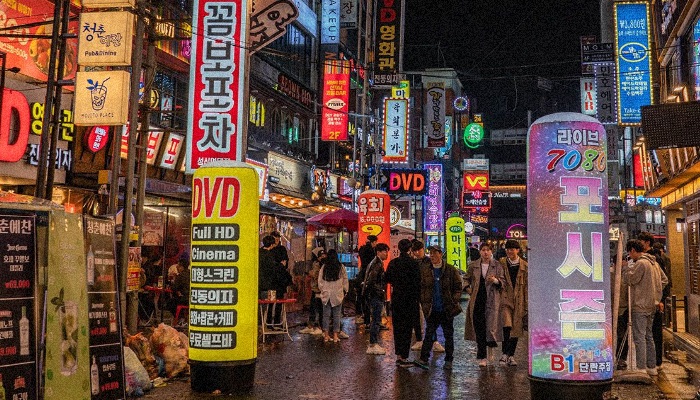
What makes it lean real cyberpunk is the mix. The street culture coexists with a kind of low-key commercial saturation that doesn’t feel sanitised. It’s not Gangnam. Things feel slightly improvised, slightly too bright, slightly too loud. That’s the point.
Mong Kok, Hong Kong
Mong Kok is the one people usually mean when they picture a real cyberpunk place in the flesh, and it earns it. It’s been called one of the most densely populated urban areas on earth, and you believe it after about thirty seconds on the street. The vertical dimension is what gets you: buildings stacked so close together that the sky is almost an afterthought, covered in layered signage, some of it barely hanging on. Neon used to define this place. A lot of the iconic signs are gone now, taken down for safety or redevelopment, but enough remains, and the LED replacements have their own kind of aggressive glow.
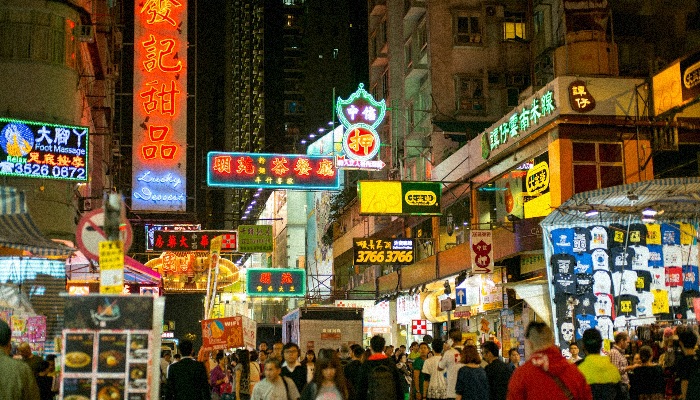
The streets at ground level are a kind of controlled disorder. Electronics stalls next to herbal medicine shops next to phone case vendors next to places selling nothing in particular. The Ladies’ Market stretches for blocks and doesn’t apologise for it. It smells like incense and drains and frying oil, which sounds bad and is actually fine.
Nakasu, Fukuoka (Japan)
Nakasu is Fukuoka’s entertainment island (literally an island, sitting between two rivers) and at night it does something specific that I haven’t really seen replicated. The yatai, small open-air food stalls, line the riverbank and cast warm orange light onto the water. Behind them are clubs, hostess bars, izakayas, and a few spots that probably don’t have websites. The combination of food stall glow and the neon signs of the taller buildings behind them, all reflected in the river, makes for something that hits differently than most nightlife districts.
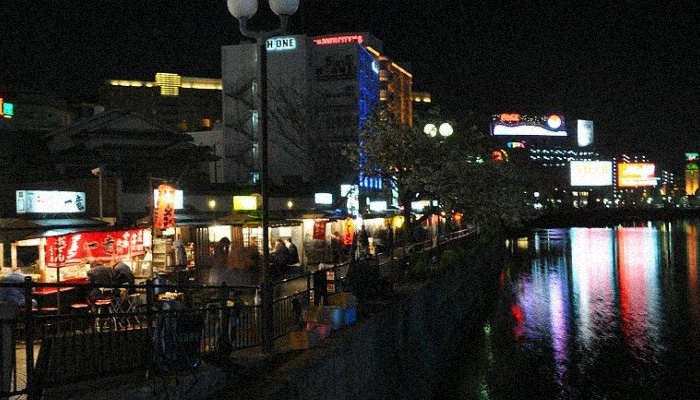
It’s smaller than you’d expect. You can walk the main stretch in fifteen minutes, but you don’t want to so you end up slowing down. Locals aren’t very proud of the fact that Nakasu has a reputation as the red-light district of Kyushu, but they’ll still happily take you for ramen there at midnight. That tracks.
Soi Cowboy, Bangkok (Thailand)
Soi Cowboy is one of Bangkok’s old entertainment strips, a single short street in Asok lined end-to-end with go-go bars, each one competing on loudness and brightness. It’s not subtle and it doesn’t try to be. The LEDs are aggressive, the touts are persistent, the music bleeds out onto the street. The whole thing is a neon corridor that looks exactly like something out of a late-90s sci-fi film set in a version of Asia that the screenwriter had never actually visited. Except it’s real and it’s been there since the 70s.
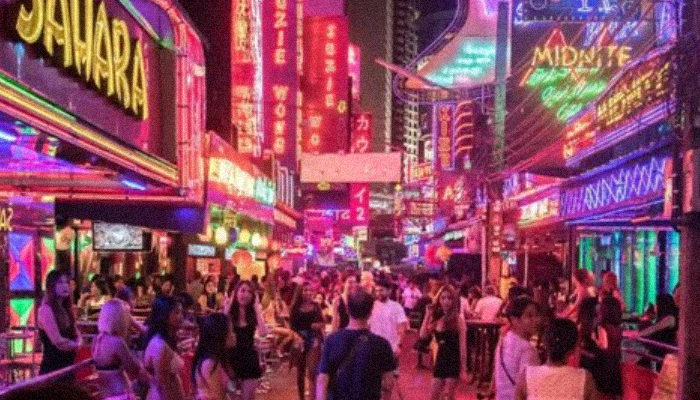
You don’t have to drink in the bars to get something out of walking it. The street itself is the experience: the visual noise, the people, the density of competing light sources at eye level. It’s one of those places where the atmosphere is completely disconnected from whatever is happening on your phone. A friend of mine ended up here accidentally after a long night and said it felt like falling into a film. He was pretty drunk, but he wasn’t wrong.
Paharganj, New Delhi (India)
Paharganj is a different kind of real cyberpunk. Less neon, more raw infrastructure. The main bazaar runs right opposite New Delhi Railway Station and has been absorbing travellers, backpackers, and people in transit for decades. The streets are narrow enough that the buildings on either side almost touch, and between them there are cables, actual physical cables, hundreds of them, hanging in loose clusters overhead like the city’s electrical system just kind of gave up trying to be tidy. Combined with the signage, the vendor carts, the perpetual density of people, and the layer of dust and spice and exhaust that hangs over everything, it reads as a place that has never, not once, been planned.
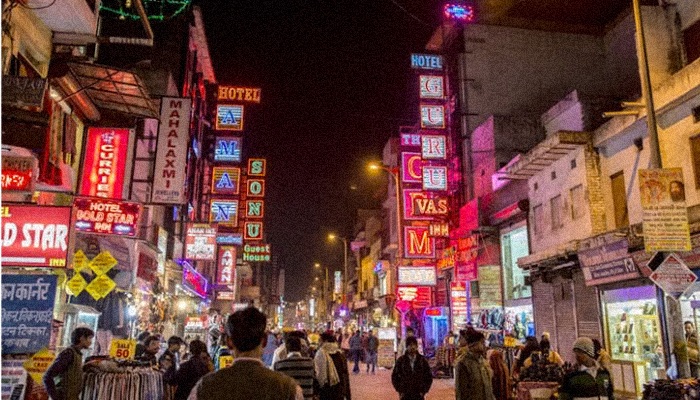
It’s a bit overwhelming at first, especially if you come straight off a long journey. But the chaos has a logic to it. Give it an hour and you start reading the patterns. The chai stalls are consistent landmarks. The touts know where the line is. Coming out of there at night on a motorbike, which is the only sensible way to move in that area, is something I remember clearly every time I think about Delhi.
There are more, obviously. Shinjuku’s Golden Gai, parts of Taipei’s Ximending, Wan Chai, Pigalle on a bad night. This list is personal and it’s not finished. But these five have the thing: the specific feeling of being somewhere too dense and too bright and too loud, where the city hasn’t been smoothed out yet. That’s the version I keep going back to.